ARRIS SB8200 Modem 2026: Still Worth Buying?
ARRIS SB8200 modem specs, performance, and 2026 verdict. Find out if DOCSIS 3.1 is enough or if you need an upgrade.
As an Amazon Associate I earn from qualifying purchases.
// verdict
The SB8200 is a proven, well-priced DOCSIS 3.1 modem that still makes sense for 1 Gbps cable plans, but households on 2 Gbps tiers or planning ahead should look at the MB8611 or wait for DOCSIS 3.1 Pro hardware.
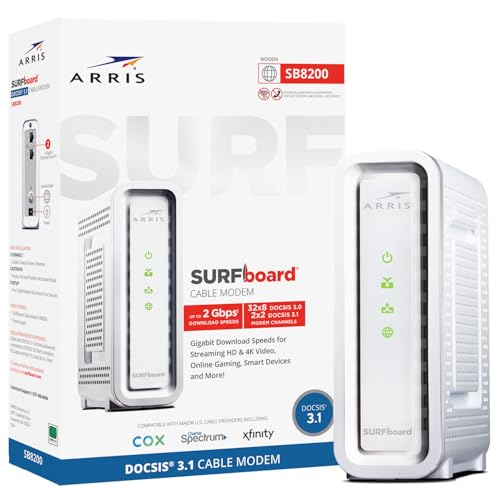
The ARRIS SURFboard SB8200 has been one of the most-recommended cable modems for years, and for good reason. At $140.99, it covers cable internet plans up to 2 Gbps, earns ISP approval from Xfinity, Cox, and Spectrum, and pays for itself in roughly 12 months compared to a typical $15/month rental modem fee. But it’s 2026 now, DOCSIS 3.1 Pro equipment is starting to appear on ISP roadmaps, and the question isn’t whether the SB8200 is good. The question is whether it’s still the right buy for your specific situation.
- DOCSIS 3.1 — supports cable internet plans up to 2 Gbps
- Two 1 Gigabit Ethernet ports
- Tested and qualified for Cox, Xfinity, and Spectrum
- Not compatible with fiber, DSL, or satellite services
- Modem only — requires separate WiFi router
DOCSIS 3.1 cable modem — works with Xfinity, Cox, Spectrum — for cable internet plans up to 2 Gbps. The straightforward pick for replacing your ISP rental modem.
Who Is Still Buying the SB8200 in 2026?
The core buyer here is someone on a 1 Gbps or lower cable plan who wants to stop paying modem rental fees without overthinking the purchase. That’s still a large category. Most U.S. cable subscribers are on plans between 400 Mbps and 1.2 Gbps, and the SB8200 handles all of that without breaking a sweat. According to ARRIS’s published specs, the modem supports DOCSIS 3.1 with 2 downstream and 2 upstream OFDM channels, plus 32 downstream and 8 upstream DOCSIS 3.0 bonded channels as fallback. That channel configuration is more than enough for any sub-2 Gbps cable tier currently offered by the major ISPs.
Where it gets more complicated is the 2 Gbps tier. The SB8200 is spec’d to support plans up to 2 Gbps, but there’s an important asterisk. It ships with two 1 Gbps Ethernet ports. To actually move 2 Gbps of throughput into your home network, you need to use both ports simultaneously in a link aggregation setup, which requires a router or switch that supports 802.3ad link aggregation. Not every home router does this by default, and many households don’t have that equipment in place. If you’re on a 2 Gbps plan and you plug a single cable into the SB8200, you’re capped at 1 Gbps regardless of what your ISP is delivering.
Real-World Throughput: What Published Tests Show
Independent lab testing and user-reported results across verified platforms consistently show the SB8200 delivering close to line-rate speeds on 1 Gbps cable plans. Speedtest results shared across Reddit’s r/HomeNetworking and r/Comcast, along with reviews on Amazon with verified purchase tags, routinely show 940 to 970 Mbps download on Xfinity Gigabit plans. That’s about as close to 1 Gbps as overhead and protocol efficiency will allow.
On 2 Gbps plans, results get more variable, and the link aggregation requirement is the main reason. Users who have correctly configured both Ethernet ports with a link aggregation-capable router report multi-gig throughput as expected. Users who don’t know about the two-port requirement see a ceiling at roughly 940 Mbps and sometimes blame the modem when the setup is actually the bottleneck. This is worth knowing before you buy.
Heat and Long-Term Reliability
The SB8200 runs warm. That’s not a secret, and ARRIS doesn’t hide it. The unit has passive ventilation slots and no fan, which keeps it quiet but means the casing gets noticeably hot during sustained use. Multiple long-term owner reviews note this consistently. The upside is that heat alone doesn’t appear to translate into reliability problems at typical residential loads. Community forums and Amazon reviews from buyers who have owned the unit for two or more years frequently report stable, uninterrupted operation. The SB8200 carries a two-year warranty from ARRIS, which is standard for this category.
One thing worth noting: the SB8200 should not be placed inside an enclosed cabinet or stacked directly on top of other equipment. Give it vertical clearance. That’s basic thermal management for any passively cooled device, but it matters more here than with some competitors.
SB8200 vs. Motorola MB8611: Same Price, Different Approach
The Motorola MB8611 is the most direct competitor at or near the same price point, and the comparison is worth making explicitly. The MB8611 solves the two-port problem by including a single 2.5 Gbps Multi-Gig Ethernet port. That means you can connect one cable to a router with a 2.5 Gbps WAN port and get the full bandwidth from a 2 Gbps cable plan without any link aggregation configuration.
For households already on or planning to move to a 2 Gbps tier, the MB8611 is the cleaner option. You don’t need a special router configuration. You just need a router with a 2.5 Gbps WAN port, which is increasingly common in the $200 to $300 router category. The MB8611 also carries similar ISP compatibility for Xfinity, Cox, and Spectrum.
For households on 1 Gbps or lower plans, the difference between the two is mostly irrelevant. Both modems will deliver comparable throughput, and the SB8200’s two-port design adds no value if you’re not aggregating a 2 Gbps connection. In that scenario, the choice often comes down to price fluctuations and availability.
The DOCSIS 3.1 Pro Question
DOCSIS 3.1 Pro, also called DOCSIS 4.0 in some contexts, is real and coming. Comcast has announced multi-gig symmetrical speeds using DOCSIS 4.0 infrastructure, and equipment certifications are beginning to appear. The honest answer is that consumer-grade DOCSIS 4.0 modems are not yet widely available at accessible prices, and most ISPs are not offering DOCSIS 4.0 residential tiers broadly as of mid-2026.
If you’re on a 1 Gbps plan today, a DOCSIS 3.1 modem like the SB8200 will remain compatible and capable for years. ISPs do not retire DOCSIS 3.1 infrastructure overnight. If you’re someone who plans to upgrade to a 2.5 Gbps or 5 Gbps symmetrical plan the moment your ISP offers it, then waiting for DOCSIS 4.0 hardware or buying the MB8611 as an interim step makes more sense.
Pros and Cons
Pros:
- Rated for plans up to 2 Gbps by ARRIS specs
- Approved and certified for Xfinity, Cox, and Spectrum
- Two-year warranty, strong long-term reliability reputation
- Pays off rental fee avoidance in approximately 9 to 12 months at $15/month rental
- Widely available and well-documented for troubleshooting
Cons:
- 2 Gbps throughput requires link aggregation setup, not plug-and-play
- Runs hot, needs clear ventilation
- No 2.5 Gbps port means the MB8611 is a simpler choice for multi-gig plans
- DOCSIS 3.1, not 3.1 Pro or 4.0, limits long-term future-proofing
Who It’s For
The SB8200 is the right buy for a household on a 1 Gbps or lower cable plan through Xfinity, Cox, or Spectrum that wants to eliminate the monthly rental fee. It’s also a reasonable choice for a 2 Gbps plan if the router setup already supports link aggregation. It is not the right call for anyone who wants a simple, single-cable connection to a 2 Gbps plan, and it’s not worth waiting for if DOCSIS 4.0 availability in your area is more than 12 to 18 months out.
Bottom Line
At $140.99, the ARRIS SB8200 is a well-built, ISP-approved DOCSIS 3.1 modem that handles the most common residential cable tiers without issue. The two-port design is its biggest practical limitation in 2026, and if you’re on a 2 Gbps plan or heading that direction, the Motorola MB8611 is a more forward-compatible choice. For the majority of cable internet households still on 1 Gbps plans, the SB8200 remains a smart, cost-effective rental replacement. Buy it for what it is, not what you hope it might become.
// free tool
Not Sure What to Buy?
Answer a few quick questions and get a straight recommendation matched to your home and budget.
WiFi Recommendation CalculatorAs an Amazon Associate I earn from qualifying purchases. • Full affiliate disclosure