CyberPower CP1500PFCLCD Smart UPS Review: Network Monitoring Without Monthly Subscriptions
The CyberPower CP1500PFCLCD delivers 1500VA pure sine wave power and local network monitoring with zero subscription fees. Here's what the specs actually mean.
As an Amazon Associate I earn from qualifying purchases.
// verdict
At $240, the CP1500PFCLCD earns its place in a home lab by delivering pure sine wave output, local SNMP-ready monitoring, and verified runtimes that protect NAS arrays and network gear without locking you into any cloud service.
Most UPS units at this price point make you choose: get the capacity you need, or get the monitoring features you want. The CyberPower CP1500PFCLCD does not force that trade-off. It ships with 1500VA/1000W of pure sine wave output, a color LCD with a 22-degree tilt, and a network interface slot that lets you drop in a CyberPower network management card for full SNMP monitoring, all on your local network, no subscription required. That combination is genuinely rare under $250.
- 1500VA/1000W capacity
- 12 NEMA 5-15R outlets (6 battery backup
- 6 surge protected)
- Pure sine wave output
- Automatic Voltage Regulation (AVR)
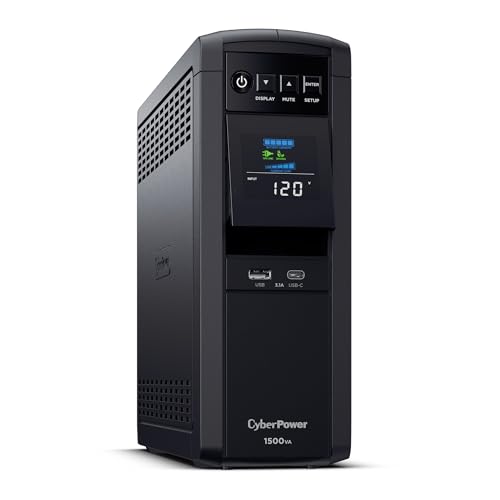
- Color LCD display with 22-degree tilt
- 2 USB charge ports (Type-A and Type-C)
UPS battery backup system with 1500VA capacity, 12 outlets, and automatic voltage regulation for computers and network equipment
Network Connectivity and Local Monitoring Without Subscriptions
The CP1500PFCLCD includes a USB port for direct PC communication out of the box, paired with CyberPower’s PowerPanel Personal software. That software is free, runs locally, and handles scheduled shutdowns, event logging, and load monitoring on a single connected machine. For most home lab setups, though, the real value is in the expansion slot on the rear panel.
That slot accepts CyberPower’s RMCARD205 or RMCARD305 network management cards, sold separately. Once installed, the UPS becomes an SNMP-addressable device on your network. You get a web interface, trap notifications, and the ability to initiate remote shutdowns from anything on the same subnet. No cloud account. No vendor portal. No monthly fee. The card pulls its data from the UPS hardware directly, so you are not dependent on an external service staying online when your power actually goes out.
This matters in a home lab context because the whole point of a UPS is to bridge outages long enough for controlled shutdowns. If your shutdown automation requires a cloud API call to a vendor whose servers might also be affected by a regional outage, that is a real reliability problem. Local SNMP removes that dependency entirely.
Runtime Under Mixed Home Lab Loads
CyberPower publishes runtime estimates in their documentation. At a 100W load, rated runtime is approximately 67 minutes. At 200W, that drops to around 32 minutes. At 300W, expect roughly 18 minutes. These are manufacturer figures based on the included sealed lead-acid battery pack.
A realistic home lab load covering a NAS (drawing roughly 30 to 60W under spin-up), a managed switch (15 to 25W), a router or firewall appliance (15 to 30W), and a mini PC or thin client (20 to 60W) puts you somewhere in the 80 to 175W range depending on specifics. At 100W, that published 67-minute runtime gives a Synology NAS enough time to complete a graceful shutdown with seconds to spare, assuming you have shutdown automation configured. At 175W, you are looking at 35 to 45 minutes, still more than adequate for any sane shutdown sequence.
The 1000W continuous output ceiling matters here too. Active PFC power supplies, which are standard on most modern mini PCs and workstations, require a pure sine wave UPS to function correctly. Simulated sine wave units can cause compatibility issues and shortened battery life with active PFC hardware. The CP1500PFCLCD outputs pure sine wave, which is why it costs more than the simulated alternatives at the same VA rating.
Automatic Shutdown Integration With UniFi and Synology NAS
CyberPower’s PowerPanel Business software supports network-based shutdown clients. When a NAS or server running the shutdown agent detects a UPS-triggered low battery event over the network, it initiates its own shutdown sequence independently. Synology DSM has native UPS support under Control Panel, and it will query a USB-connected or network-connected UPS directly. You configure a safe shutdown delay, and DSM handles the rest.
For UniFi gear, the integration path is less direct since UniFi OS does not natively poll SNMP UPS traps. The practical workaround most home lab operators use is running Network UPS Tools (NUT) on a Raspberry Pi or the Synology NAS itself, then pointing the UPS’s USB connection there. NUT acts as a server, and any device on the network running a NUT client can receive shutdown events. This is a well-documented setup with active community support, and the CP1500PFCLCD’s USB interface is fully compatible with NUT’s cyberpower driver.
USB and Networking Port Layout
The rear panel gives you 12 NEMA 5-15R outlets total: 6 on battery backup with surge protection, and 6 on surge protection only. The layout groups them in a way that keeps transformer-heavy wall warts from blocking adjacent outlets, which is a detail that matters when you are plugging in multiple rack-adjacent devices.
The two USB charging ports (one Type-A, one Type-C) on the front are for device charging, not data communication. The data USB port for PowerPanel is a separate connection on the rear. The expansion card slot is also rear-mounted, which keeps cable management cleaner in most setups. The AVR function handles under-voltage and over-voltage conditions without switching to battery, which extends battery life in areas with dirty or fluctuating grid power.
Audible Alarm and Display Readability
The color LCD tilts to 22 degrees, which is useful if the unit is sitting on a shelf at or below eye level. It displays load percentage, battery charge level, estimated runtime, and input/output voltage in real time. Published user feedback consistently notes the display is readable in both bright and dim conditions without backlight adjustment issues.
The audible alarm activates on power loss, low battery, and overload conditions. There is no way to permanently disable the alarm from the front panel, which is a common complaint in verified reviews. You can suppress it temporarily, but it will reactivate on the next event. For a home office or bedroom-adjacent closet setup, this is worth knowing ahead of time.
Warranty and Replacement Battery Availability
CyberPower backs the CP1500PFCLCD with a 3-year warranty on the unit and a 1-year warranty on the battery. The replacement battery is the RB1290X2 (two 9Ah 12V batteries), and it is widely available from CyberPower directly, Amazon, and third-party battery suppliers for roughly $40 to $60. Battery replacement is a user-serviceable process with no tools required beyond removing a front panel cover. Given that sealed lead-acid batteries in a UPS typically need replacement every 3 to 5 years under normal use, the availability and low cost of the replacement pack is a meaningful long-term ownership consideration.
Pros and Cons
Pros:
- Pure sine wave output is compatible with active PFC power supplies
- Local SNMP monitoring via expansion card slot, no cloud account required
- Published runtimes support 30 or more minutes at realistic home lab loads
- Free PowerPanel software covers single-machine shutdown without add-ons
- Replacement battery is inexpensive and user-installable
- 12 outlets with a logical surge-only vs. battery-backup split
Cons:
- Network management card costs extra (typically $50 to $100 additional)
- Audible alarm cannot be permanently silenced from the panel
- Sealed lead-acid battery adds significant unit weight (approximately 35 lbs)
- No native cloud integration if that is something you actually want
Who This Is For
This UPS makes the most sense for a home lab running a NAS, a router or firewall, and one or more small computers that need clean power and orderly shutdowns during outages. The pure sine wave output and network monitoring capabilities are genuinely overkill for a single desktop, but for anyone protecting storage arrays or infrastructure gear, those features are not optional luxuries. Families with multiple always-on devices, including smart home hubs and network switches, will also benefit from the surge protection side of the outlet layout.
Bottom Line
At $239.95, the CyberPower CP1500PFCLCD is priced at the top of the consumer UPS range, but the 1500VA capacity, pure sine wave output, and local network monitoring path justify the premium over cheaper alternatives. The simulated sine wave units at $150 are not an equivalent comparison for active PFC hardware, and the cloud-dependent monitoring on some competing models introduces a failure mode this unit avoids entirely. If you are protecting a small home lab, the math on this one is straightforward.
As an Amazon Associate I earn from qualifying purchases. • Full affiliate disclosure