CyberPower vs APC UPS: 3 Models Compared Side-by-Side
Compare 3 CyberPower and APC UPS models head-to-head. Runtime, price, and power output for home office and lab setups.
3 CyberPower and APC UPS Units Compared: Which Battery Backup Fits Your Home Setup
Most people don’t think about a UPS until their computer dies mid-project during a thunderstorm. Then they panic-buy whatever is cheap and available, end up with something that barely covers their router for three minutes, and wonder why they bothered. Let’s skip that part.
A UPS, or uninterruptible power supply, does two things: it protects your equipment from power spikes and surges, and it keeps your gear running long enough during an outage to save your work, shut down gracefully, or wait out a brief blip. The right one depends on what you’re protecting and how much wattage that gear actually pulls. The wrong one is either overkill or useless.
Here are three specific models worth considering, at three different price points, covering everything from a basic desk setup to a home server rack.
What Actually Matters When Choosing a UPS
Before getting into the models, a quick word on specs that matter. VA (volt-amperes) and watts are both listed on every UPS, and they’re not the same number. Watts reflect real power consumption. When you’re sizing a UPS for your gear, add up the wattage on the devices you want to protect, then make sure the UPS’s watt rating exceeds that total with some headroom.
The other spec worth paying attention to is output waveform. A pure sine wave UPS outputs clean, smooth power, which is what active PFC power supplies (common in modern desktop PCs and servers) need to function properly. A simulated sine wave, or stepped approximation, works fine for most simple electronics but can cause problems with sensitive equipment. More on that below.
The Budget Pick: CyberPower ST425 for Basic Home Office Gear
At $59.96, the CyberPower ST425 sits at the entry level of the UPS market. It’s rated at 425VA/260W, which is a realistic capacity for a home router, a network switch, a modem, and maybe a small external hard drive. That’s it. Don’t try to run a desktop computer on this thing.
The ST425 gives you 8 outlets total: 4 with battery backup and 4 with surge protection only. The battery backup side is where you plug your critical gear. The surge-only side is for peripherals like a printer or a lamp that don’t need battery support.
The output is simulated sine wave. For the type of gear this UPS is designed to protect, that’s fine. Routers, modems, and basic networking hardware are not sensitive to waveform. The 5-foot power cord gives you decent reach, and the 3-year warranty with battery replacement is solid coverage at this price.
Where this unit falls short is transparency. There’s no LCD display, no USB monitoring port, and no software integration. You plug it in, a light tells you it’s working, and that’s the extent of the feedback. For a router closet or a simple desk setup with a laptop, that’s probably acceptable. For a desktop workstation or anything with an active PFC power supply, look elsewhere.
The 260W ceiling is the hard limit here. A typical gaming PC can pull 300-500W under load. A modest business desktop with a monitor can hit 150-200W. Stack a monitor, a computer, and a few peripherals together and you’ll exceed this unit’s capacity immediately. Know what you’re plugging in before you buy.
- 425VA/260W capacity
- 8 NEMA 5-15R outlets
- 4 battery backup outlets
- 4 surge protected outlets
- Simulated sine wave output
- 5-foot power cord
- 3-year warranty with battery
Standby UPS system with battery backup for home office and entertainment devices

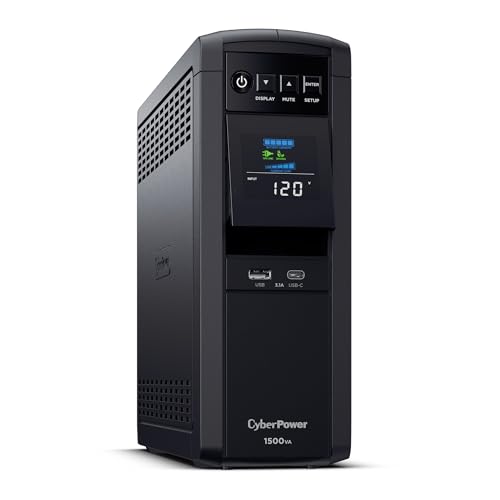
The Mid-Range Option: CyberPower CP1500PFCLCD for Workstations and NAS Devices
The CyberPower CP1500PFCLCD jumps to $239.95 and delivers a substantial capacity increase: 1500VA and 1000W. That’s enough to run a mid-range desktop PC, a 27-inch monitor, a NAS device, and your networking gear simultaneously, with room to spare.
The standout feature here is the pure sine wave output. CyberPower labels this as PFC Sinewave, meaning it’s compatible with active PFC power supplies. That matters if you’re running a modern desktop PC. Active PFC power supplies, which are standard in most desktops built in the last decade, can behave erratically or even shut down when fed simulated sine wave power. Pure sine wave eliminates that risk entirely.
You also get Automatic Voltage Regulation (AVR), which corrects under-voltage and over-voltage conditions without drawing on the battery. In areas where brownouts are common, this extends battery life significantly because the UPS isn’t constantly cycling the battery just to compensate for dirty grid power.
The color LCD display with a 22-degree tilt is genuinely useful. It shows load percentage, estimated runtime, input/output voltage, and battery charge level at a glance. That kind of visibility lets you make informed decisions about what to add or remove from the circuit.
The outlet count is generous: 12 total, split evenly between 6 battery backup and 6 surge-only. Two USB charging ports, one Type-A and one Type-C, are a practical bonus for keeping a phone or tablet charged during an outage without wasting a NEMA outlet.
For a home office running a desktop workstation, a NAS, dual monitors, and a networking stack, this is the most capable unit in the sub-$250 range. The combination of pure sine wave output, 1000W capacity, and detailed LCD monitoring makes it the right call for anyone who can’t afford an unexpected shutdown mid-project.
- 1500VA/1000W capacity
- 12 NEMA 5-15R outlets (6 battery backup
- 6 surge protected)
- Pure sine wave output
- Automatic Voltage Regulation (AVR)
- Color LCD display with 22-degree tilt
- 2 USB charge ports (Type-A and Type-C)
UPS battery backup system with 1500VA capacity, 12 outlets, and automatic voltage regulation for computers and network equipment
The Best Overall: APC Back-UPS Pro 1500VA (BR1500G) for Serious Home Office Setups
The APC BR1500G sits at $293.38 and earns the best overall designation for a few specific reasons beyond just wattage.
The specs: 1500VA/865W, 10 outlets (5 with battery backup, 5 surge-only), AVR with active PFC compatibility, Energy Star certified, and an expandable battery option via the BR24BPG external battery pack (sold separately). That last feature matters for anyone running a home server or a workstation where extended runtime is a real requirement, not just a nice-to-have.
The 865W rating is worth noting in comparison to the CyberPower CP1500PFCLCD’s 1000W at the same VA rating. The APC’s power factor is slightly lower (0.577 vs. 0.667), meaning it delivers somewhat less real power from the same VA capacity. For most home office loads, 865W is still more than adequate. But if you’re running a high-wattage gaming PC or a power-hungry workstation, the CyberPower wins on raw watts.
Where APC pulls ahead is reliability reputation and software support. APC’s PowerChute software (free for Windows) provides detailed monitoring, scheduled shutdown automation, and power event logging. Mac users are directed to native Energy Saver settings, which is less feature-rich but functional. APC has decades of documented use in enterprise environments, and the BR1500G’s battery replacement path is straightforward using the APCRBC124 replacement battery.
The right-angle NEMA plug is a small but thoughtful design detail. It keeps the unit flush against a wall or desk without the cord jutting straight out. That kind of physical design consideration is easy to overlook until you’re trying to fit a UPS behind a desk in a tight corner.
Energy Star certification means the standby power consumption is rated efficiently, which matters over a device that runs 24/7 for years. The expandable battery option via external pack is the feature that separates this from the CyberPower at similar capacity: if you need 30 minutes of runtime instead of 10, you have a path to get there without buying an entirely different unit.
For a home office where downtime has actual financial consequences, whether that’s client calls dropping, a server being unavailable, or files being corrupted mid-save, the APC BR1500G gives you the most flexibility and the most documented reliability track record of the three options here.
- APC 1500 VA / 865W battery backup power supply
- 10 Outlets (NEMA 5-15R): 5 surge protector with battery backup; 5 outlets with Surge Protection Only
- Automatic Voltage Regulation (AVR): instantly corrects low/high voltage fluctuations without discharging the battery, and is Active PFC compatible
- A supplemental external Battery Pack provides even more runtime during outages (Sold Separately, model BR24BPG)
- 6' Power Cord, right-angle 3-prong wall plug (NEMA 5-15P), and free Windows PC power-management software (Mac OS uses native "Energy Saver" Settings); Replaceable battery (model APCRBC124, sold separately)
- Energy-Star Certified: This UPS meets the Energy Star Program Requirements for product specification: Uninterruptible Power Supplies (UPS)
Professional-grade UPS that keeps your home office (or small server) alive during power outages without the enterprise price tag.

Side-by-Side: Which UPS Handles What
Here’s a direct breakdown of which load each unit is actually suited for:
CyberPower ST425 ($59.96): Router, modem, a network switch, and a small external drive. Not for desktops. Simulated sine wave limits it to non-PFC equipment.
CyberPower CP1500PFCLCD ($239.95): Mid-range desktop workstation, NAS device, dual monitors, full networking stack. Pure sine wave handles active PFC power supplies. Best watts-per-dollar in this comparison.
APC BR1500G ($293.38): Home server, workstation, networking stack, plus the option to add an external battery pack for extended runtime. Best choice when reliability documentation and runtime expandability matter.
The Simulated vs. Pure Sine Wave Question
This comes up constantly in UPS buying decisions, so it’s worth being direct about it. If your computer has an active PFC power supply, and most modern desktops do, you need a pure sine wave UPS. Plugging an active PFC power supply into a simulated sine wave UPS during an outage can cause the power supply to click off, generate audible noise, or in some cases reduce its lifespan.
Both the APC BR1500G and the CyberPower CP1500PFCLCD deliver pure sine wave or active PFC-compatible output. The CyberPower ST425 does not. That’s the single biggest reason to skip the ST425 for anything beyond basic networking gear.
Runtime Expectations
No UPS review is complete without an honest note on runtime. A 1500VA unit is not going to run your desktop computer for an hour. Under a realistic 300W load, a 1500VA UPS typically provides 10-20 minutes of runtime, depending on battery age and actual load. The purpose of a home office UPS is to give you time to save your work and shut down cleanly, not to serve as a generator replacement. If you need extended runtime for a server or critical equipment, the APC BR1500G’s external battery expansion is the most accessible path at this price tier.
For most home office situations, a clean 10-15 minute window is exactly what you need. It covers brief outages entirely and gives you a safe shutdown window for the longer ones.
Making the Call
If you’re protecting a router and a modem on a tight budget, the ST425 does the job. If you’re running a desktop workstation and need clean power protection with visibility into what’s happening, the CyberPower CP1500PFCLCD is the strongest value. If you want the most reliable name in UPS hardware with a path to extended runtime and solid software support, the APC BR1500G justifies the price premium. Pick the one that matches the wattage of what you’re actually plugging in, and make sure the sine wave output matches your equipment’s requirements.
As an Amazon Associate I earn from qualifying purchases. • Full affiliate disclosure