Aeotec Smart Home Hub (SmartThings Compatible, Matter) Review
The Aeotec Smart Home Hub bridges Z-Wave, Zigbee, and Matter under one roof. Here's what you need to know before buying.
As an Amazon Associate I earn from qualifying purchases.
// verdict
The Aeotec Smart Home Hub is the most practical way to bridge Z-Wave, Zigbee, and Matter devices into a single SmartThings-powered ecosystem, though its $149.99 price tag demands that you're already bought into that platform.
Four wireless protocols in one box. That’s the core pitch of the Aeotec Smart Home Hub, and it’s a pitch worth taking seriously. For anyone who has spent years accumulating Z-Wave locks, Zigbee sensors, and a growing pile of Matter-compatible gadgets, the idea of a single hub that speaks all those languages without a drawer full of separate bridges is genuinely appealing. Whether the reality lives up to that pitch is what this review is here to figure out.
- Z-Wave Plus V3
- Zigbee certified
- Matter gateway
- Wi-Fi and Ethernet connectivity
- SmartThings app compatible
- Works with Alexa and Google Home
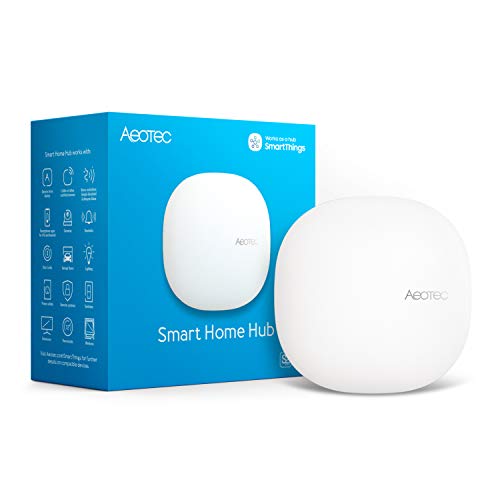
Smart home hub supporting Z-Wave, Zigbee, Matter, and Wi-Fi for device control and automation.
Overview
The Aeotec Smart Home Hub launched as the official hardware replacement for the Samsung SmartThings Hub after Samsung exited the hardware business. Aeotec makes the physical device, but it runs the full SmartThings platform, which means you get Samsung’s app, automations engine, and cloud infrastructure. That relationship is important to understand before buying: you’re not purchasing a standalone, locally-processed hub. This is a SmartThings hub in a new shell, with Aeotec’s radio hardware inside.
The hub connects to your network via Ethernet or Wi-Fi, supports both 2.4GHz and 5GHz bands, and handles Z-Wave Plus V3, Zigbee, Matter, and Wi-Fi device control from one interface. It’s a fairly compact device, roughly the size of a thick paperback book, and the setup process runs entirely through the SmartThings app.
Specs Analysis
Let’s go through what actually matters in these specs.
Z-Wave Plus V3 is the current-generation Z-Wave standard, operating on the 908.42 MHz frequency in North America. This matters because Z-Wave Plus devices offer longer range (up to 100 meters line-of-sight), improved battery life for sensors, and better network reliability compared to older Z-Wave generations. The hub supports a Z-Wave mesh network, which means every powered Z-Wave device in your home acts as a repeater, extending range as your network grows.
Zigbee support follows the Zigbee 3.0 standard. Zigbee operates on the 2.4GHz band, which means it can compete with Wi-Fi and Bluetooth for spectrum in a busy home. That said, Zigbee 3.0 consolidated several older Zigbee profiles into one, so compatibility with modern Zigbee devices is broad. Popular Zigbee ecosystems like Philips Hue (without a separate bridge), IKEA TRÅDFRI, and many Aqara sensors work directly with this hub.
Matter support positions this hub as a Thread Border Router and Matter controller. Matter, the IP-based smart home standard backed by Apple, Google, Amazon, and the Connectivity Standards Alliance, is designed to make cross-platform compatibility the default rather than the exception. As a Matter gateway, this hub can add Matter-certified devices to your SmartThings setup without additional hardware. It’s worth noting that Matter over Thread requires Thread Border Router capability, which this hub provides.
Wi-Fi and Ethernet connectivity gives you flexibility in placement. Ethernet is generally the better choice for a hub, since it removes one potential point of failure from your automations. The hub does not act as a Wi-Fi router or access point; it connects to your existing network.
The SmartThings platform supports over 5,000 compatible devices across all protocols, according to Samsung’s published compatibility documentation. That’s a meaningful number when you’re evaluating whether your existing or future devices will work.
Pros and Cons
Pros:
- Four protocol support at one price point. At $149.99, you’re getting Z-Wave Plus, Zigbee, Matter, and Wi-Fi in a single device. Buying separate bridges for each protocol would cost significantly more and create a more complex setup.
- SmartThings automation depth. The SmartThings platform offers conditional automations, scenes, and routines that go well beyond what most single-protocol apps provide. Mixing a Z-Wave door lock with a Zigbee motion sensor in one automation is straightforward.
- Broad device compatibility. The 5,000-plus device library means most mainstream smart home products will work without workarounds.
- Matter future-proofing. As Matter adoption grows, having a hub that can already act as a Matter controller and Thread Border Router is a real advantage.
- Ethernet option. Wired connection keeps your hub reliable even when Wi-Fi networks get congested.
Cons:
- Cloud dependency. SmartThings still relies heavily on cloud processing for automations. If Samsung’s servers have an outage, some automations may stop working. Locally-processed hubs like Home Assistant-based options give you more control here.
- Samsung platform risk. Samsung already handed off the hardware once. The long-term future of SmartThings as a platform is a legitimate concern for buyers who want to invest heavily in their setup.
- No local voice processing. You’ll need Alexa or Google Home for voice control, adding another layer of platform dependency.
- App can be inconsistent. User reviews on Amazon and community forums like the SmartThings subreddit frequently mention that the app’s interface feels cluttered and that device management can be unintuitive, particularly when dealing with multi-protocol households.
- $149.99 is a real commitment. This is not a budget entry point. For homes with mostly Wi-Fi devices or a single-protocol setup, it may be more hub than needed.
Who It’s For
This hub makes the most sense for a few specific situations.
Homes with existing Z-Wave or Zigbee devices that are already using SmartThings are the obvious target. If you’ve built a setup around SmartThings and need updated hardware, this is the direct path forward.
Multi-protocol households, meaning homes that have accumulated devices across Z-Wave, Zigbee, and newer Matter products, will get real value from consolidating everything into one app rather than juggling multiple bridges and apps.
People planning a larger smart home build who want a single platform to grow into will benefit from the depth of SmartThings automations and the 5,000-device compatibility list.
It’s probably not the right buy for someone who has five Wi-Fi smart plugs and wants to automate their lights. That use case is served by cheaper, simpler options. It’s also a harder sell for anyone who values local processing above all else, since Home Assistant with a Z-Wave USB stick and Zigbee coordinator gives you full local control at a comparable price, albeit with significantly more setup complexity.
Bottom Line
The Aeotec Smart Home Hub earns its place as the de facto SmartThings hub in a market where Samsung no longer makes its own hardware. Four protocols, a massive device compatibility list, and Matter support for future devices make the technical case clearly. The concerns are real but platform-level, not hardware-level: cloud dependency, Samsung’s track record with smart home products, and an app that could use a redesign are all worth factoring into your decision.
At $149.99, this hub rewards buyers who are committed to building out a multi-protocol smart home on the SmartThings platform. If that describes your situation, it’s a well-built, capable piece of hardware that does exactly what it says.
As an Amazon Associate I earn from qualifying purchases. • Full affiliate disclosure