4 Anker SOLIX Power Stations Compared: Which 288Wh to 3840Wh Model Fits Your Family
Compare Anker SOLIX power stations from 288Wh to 3840Wh. Find the right capacity and output for camping, mobile work, or whole-home emergency backup.
Choosing a power station is a math problem. If you buy too little capacity, your devices die before the sun comes up or the storm passes. If you buy too much, you carry around massive weight and extra cost for power you will never actually draw. Anker’s SOLIX lineup covers a massive spectrum of needs, ranging from small handheld units for phones to heavy duty systems capable of running appliances.
To pick the right one, you have to look past the marketing and focus on two specific numbers: Watt-hours (Wh) and Watts (W). Watt-hours tell you how much total energy is in the tank, much like the size of a gas tank. Watts tell you how much electricity can flow out of the station at once, which determines whether you can run a small laptop or a large coffee maker.
Understanding Capacity and Output
Before looking at the specific models, you need to understand how these specs dictate your actual usage. A 288Wh unit is great for keeping tablets, phones, and drones alive during a weekend trip. It is not going to run a heater or a toaster. On the other end of the spectrum, a 3840Wh unit is a legitimate home backup tool.
The chemistry also matters. Anker uses LiFePO4 (Lithium Iron Phosphate) in most of these models. This chemistry is rated for much higher cycle counts than standard lithium-ion batteries. While a standard battery might start showing degradation after 500 cycles, these LFP batteries are rated for 3,000 cycles or even 10,000 cycles depending on the model. This means they can last for a decade of regular use.
The Smallest Footprint: Anker SOLIX C300
The 288Wh LiFePO4 battery inside the C300 makes this a highly portable option for mobile work or light camping. It provides a 300W continuous output with a 600W surge capacity. This is enough juice for most laptops, small fans, LED lights, and certainly for charging mobile devices.
One of the standout features of this specific model is the port selection. It includes eight ports, featuring two 140W USB-C outlets. For people using high-powered laptops like a MacBook Pro, that 140W output is vital for maintaining fast charging speeds. It can also hit an 80% charge in just 50 minutes from a wall outlet, which is a quick turnaround for such a small unit.
If you are looking for a way to keep small electronics running during a short power outage or while sitting in a park, this is a low-weight choice. It is compatible with 60W or 100W Anker solar panels, making it a viable setup for off-grid power.
- 288Wh LiFePO4 battery with 300W output and 600W surge
- 8 ports including 3x AC outlets and 2x 140W USB-C
- Recharge to 80% in 50 minutes via wall outlet
- Compatible with 100W or 60W Anker solar panels
- LiFePO4 rated for 3000 cycles with 5-year warranty
Portable 288Wh power station with 300W output, 8 charging ports, and 140W USB-C fast charging

The Mid-Range Performer: Anker SOLIX C1000 Gen 2
Moving up the scale, the 1,024Wh capacity of the C1000 Gen 2 changes the utility of the device entirely. You are no longer just charging small electronics; you are managing larger devices. With a 2,000W continuous output and a 3,000W peak, this unit can handle higher-wattage appliances that the C300 simply cannot touch.
The recharge speed on this model is particularly high. It can reach a full charge in 49 minutes when using a 1,600W input. This is critical for situations where you have limited time to prep for a trip or a storm. If you plan to use solar power, it can accept up to 600W of solar input, allowing for a full recharge in about 1.8 hours under ideal conditions.
This model also functions as a UPS (Uninterruptible Power Supply). It features a 10ms switchover time, which means if the main power in a home fails, this station can take over the load for critical devices like a desktop computer or a router before they lose power. The 10 output ports also make it effective for groups or families with multiple devices needing charge simultaneously.
- 1024Wh capacity with 2000W output (3000W peak)
- 49 minute recharge time at 1600W
- 10 output ports support up to 10 devices
- 1.8 hour solar recharge with 600W input
- 10ms UPS switchover for critical devices
Portable power station with 1,024Wh capacity and 2,000W output for camping and emergency backup

The High-Capacity Standard: Anker SOLIX S2000
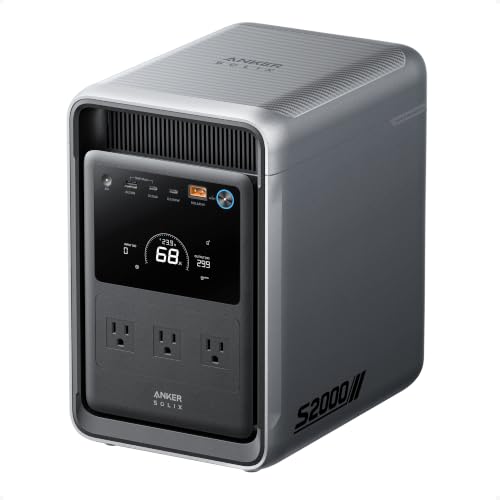
For those who need significant energy storage without moving into the realm of permanent home installations, the 2,010Wh capacity of the S2000 is a sweet spot. This model is built around a high-cycle LFP battery rated for 10,000 cycles, which is impressive for longevity.
Its performance numbers are heavy-duty. It offers a 1,500W continuous output and a 3,000W peak. Anker has managed to make this unit 30% smaller and 25% lighter than previous iterations in this class, which is important because a 2,000Wh battery is inherently heavy. In practical terms, Anker claims this unit can run a refrigerator for up to 35 hours on a single charge.
The solar capability is also a step up, accepting 400W of solar input. This makes it a primary power source for longer stays in locations without grid access. It is an ideal middle ground for families who want to keep fridge lights, internet routers, and some kitchen appliances running during an extended outage.
- Battery: 2010Wh LFP with 10000 cycle lifespan
- Output: 1500W continuous and 3000W peak
- Weight: 35.7 lbs (30% smaller and 25% lighter)
- Recharge: 400W solar input plus AC wall outlet
- Runtime: 35 hours operating a refrigerator
Anker SOLIX S2000 portable power station with 2,010Wh capacity and 3,000W peak output
The Home Backup Giant: Anker SOLIX F3800
The 3,840Wh capacity of the F3800 moves this device out of the “portable gadget” category and into the “home energy system” category. This is not a unit you carry in a backpack. This is a unit designed to sit near your main electrical panel or in an RV setup to provide serious power.
The output capacity is massive at 6,000W. Most importantly, it supports 120V/240V dual voltage. This is a critical distinction. Most portable power stations only offer standard 120V outlets. The F3800 can power heavy-duty appliances like well pumps, central air conditioners, or electric dryers that require 240V. It also features NEMA 14-50 and L14-30 ports, allowing you to plug in an electric vehicle (EV) or an RV directly.
If 3,840Wh is not enough, the system is expandable. You can connect additional battery packs to increase the total capacity up to 26.9kWh. This makes it a modular system that grows with your needs. Managing the unit is done through Wi-Fi and Bluetooth via an app, which lets you monitor power draw and battery levels from another room or even from a different location.
- 3840Wh capacity with expandable to 26.9kWh via battery packs
- 6000W AC output with 120V/240V dual voltage support
- NEMA 14-50 and L14-30 ports for EV and RV charging
- LFP battery with 10-year lifespan and 5-year warranty
- Wi-Fi and Bluetooth app control for remote monitoring
3,840Wh portable power station with 6,000W output for home backup, RVs, and EV charging

Comparison Chart: Quick Specs Reference
| Feature | SOLIX C300 | SOLIX C1000 Gen 2 | SOLIX S2000 | SOLIX F3800 |
|---|---|---|---|---|
| Capacity | 288Wh | 1,024Wh | 2,010Wh | 3,840Wh |
| Continuous Output | 300W | 2,000W | 1,500W | 6,000W |
| Peak Output | 600W | 3,000W | 3,000W | N/A |
| Best Use Case | Phones/Laptops | Camping/Small Appliances | Appliances/Fridge | Home Backup/EV |
| Expandable? | No | No | No | Yes (to 26.9kWh) |
How to Choose the Right Wattage
When you are deciding between these four, do not just look at the total capacity. You must look at the specific devices you intend to plug in.
If you are a digital nomad who only needs to charge a laptop, a tablet, and a phone while working from a van or a cafe, the C300 is plenty. It is affordable and highly portable.
If you are a camper who wants to run a blender, a small electric heater, or a projector for outdoor movies, the C1000 Gen 2 is the minimum requirement. The 2,000W output gives you the breathing room needed for those motor-driven or heating appliances.
If your goal is emergency preparedness for a household, the S2000 and F3800 are the real contenders. The S2000 is great for keeping the essentials running: lights, phones, and the refrigerator. The F3800 is for when you do not want to compromise on lifestyle during an outage. If you want to keep the AC running or charge your electric car, the F3800 is the only option in this list that can handle that level of electrical demand.
Solar Charging and Sustainability
For any of these units, solar charging is the best way to ensure long-term autonomy. A power station is only as good as its ability to refill.
The C300 is a budget-friendly solar setup. Using 60W or 100W panels, you can maintain a steady trickle of power for small electronics. The C1000 Gen 2 and S2000 are much more efficient for solar users, with the C1000 capable of accepting 600W. This means you can deploy a large array of panels and get back to full capacity in a matter of a few hours of sunlight.
When planning a solar setup, remember that solar input is rarely constant. Clouds and the angle of the sun will fluctuate. Choosing a unit with a higher solar input capacity, like the C1000 or the F3800, provides more flexibility to capture energy even when conditions are not perfect.
Final Breakdown of Value
Each of these Anker SOLIX models serves a very different part of the market.
The C300 is an affordable pick for individuals who need mobile power for personal electronics. It is a specialized tool for travel and light outdoor use.
The C1000 Gen 2 is a versatile mid-range option. It offers a high power-to-weight ratio that makes it attractive for people who want more than just phone chargers but still need to be able to move the unit around easily.
The S2000 is a heavy-duty battery for serious users. It focuses on extreme longevity with its 10,000-cycle rating and provides enough capacity to handle significant household tasks.
The F3800 is a premium investment in home infrastructure. It costs more than most competitors in the portable battery space, but it provides capabilities—like 240V output and massive expansion—that standard portable units simply cannot match. It is a replacement for a much larger, stationary home backup system.
As an Amazon Associate I earn from qualifying purchases. • Full affiliate disclosure